JULY 2026
The Security Dispatch
Vol 1 · Issue 01
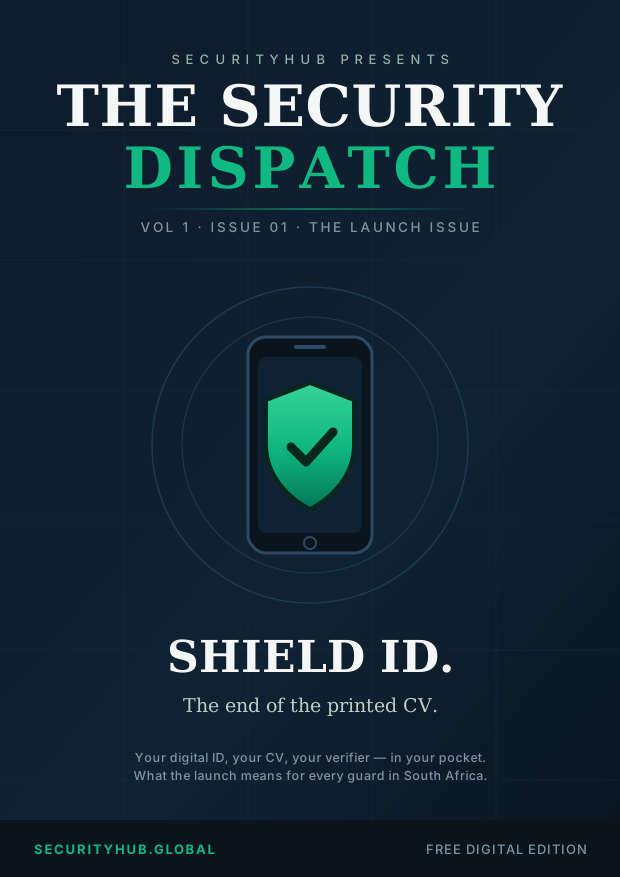
SHIELD ID. The end of the printed CV.
SECURITYHUB.CO.ZA
JULY 2026
Introducing Shield ID — your digital ID, CV and verifier, and what it means for every guard in South Africa.
JULY 2026
Vol 1 · Issue 01
Editor's Note
Welcome to this month's issue. Edit this page in the admin builder to share your editor's note.
Welcome to the Directory
Companies that joined SecurityHub in the past month — say hello.
Feature
A free app, a verified profile, every employer in one place — and the printed CV finally retires.
For the past two decades, the South African security industry has run on paper. Paper rosters. Paper incident reports. And — most stubbornly — paper CVs.
A guard looking for a new posting would walk between gate-houses with a plastic sleeve of dog-eared photocopies. Each application cost roughly R8 to R15 to print, another R20 to R40 in taxi fare to drop off, and a day off-shift. For a Grade C guard earning the SD6 minimum, that is the better part of a daily wage spent every time they try to climb a rung.
This month, that ends.
Today SecurityHub launches Shield ID — a free mobile application built specifically for South Africa''s security personnel. Shield ID puts a guard''s full PSIRA-verified profile, training record, references, and shift availability into one app, and connects them in real time to every Shield ID-enabled employer in the country.
Shield ID is not a job board. Job boards push CVs at employers and hope. Shield ID is a verified, living profile that stays current as a guard works, trains, and earns service years. When an employer searches for “Grade B armed response, Centurion, available weekends,” Shield ID returns guards who actually match — and the guard sees the offer in seconds, not in a printed advert two weeks later.
Three things make it different:
Three things, and they are not small.
The cost of trying disappears. A printed CV cost a guard between R200 and R400 a month in print, transport and lost shifts when they tried to move. Shield ID takes that to zero. For a household running on the SD6 Grade C base, that is groceries.
The whole industry opens up. Today most guards only learn of openings inside the company they already work for, or by walking past a gate. With Shield ID, a guard in Mamelodi can see a posting in Midrand the moment it goes live, and apply with one tap. The market becomes national for the first time.
Upskilling pays back, immediately. Every Shield ID profile shows a guard''s training history — PSIRA grade upgrades, first-aid, fire-arm, control-room, supervisor certificates. The app surfaces SASSETA-funded courses the guard qualifies for, books them in-app, and adds them to the profile the day they''re completed. A new ticket on Wednesday becomes a new offer on Thursday.
If you can lift your phone, you can lift your career. That is the single sentence we built Shield ID around.
Operators tell us the same three stories on every site visit: we cannot find verified Grade B fast enough; we lose two days a week to onboarding paperwork; we have no idea who we are competing against on wages. Shield ID answers all three.
South Africa''s 580,000 active security personnel are one of the largest formally employed workforces in the country. They are also one of the lowest-paid, with the highest barriers to mobility. Every rand a guard spends on photocopies, taxi fare or unpaid leave to apply for a better job is a rand taken out of a household running on R6,500 a month.
Shield ID was built as a platform service, not a product line. Guards do not pay. The cost of running it is carried by the employers and training providers who already pay for SecurityHub — not by the people the industry is built on.
We think of it the way we think of the printed CV: a relic of a time when the only way a guard could prove who they were was to carry it on paper. That time ends today.
Shield ID is available now on Android, with iOS following in eight weeks. Search “Shield ID SA” on Google Play, or visit securityhub.global/shield-id. The first 10,000 guards to register before 30 June get a free PSIRA renewal reminder service for life — a small thank-you for being there at the start.
— The SecurityHub Editorial Team
Profile
Thabo Mokoena spent six years applying for postings on photocopied paper. In the Shield ID pilot, he was hired in three days.
Thabo Mokoena is at the Pretoria North corner taxi rank by 05:45, the same way he has been for the last six winters. The difference is in his pocket.
For the past five months, Thabo (34, Grade B, PSIRA registered since 2018) has been one of 412 guards in the Shield ID closed pilot. Before pilot, he was working a single armed-response shift in Mamelodi East and trying, on weekends, to find a second posting closer to home. “I would print twenty CVs at a time,” he says. “Each one R12 at the internet cafe. Then taxi to the company, drop it, taxi home. Three weeks later, no answer. Print again.”
In March, he installed Shield ID and let it pull his PSIRA grade, his three SASSETA training certificates, and his current employer reference. Within ninety minutes he had been viewed by two estate-management companies in Centurion. Within three days he had a second contract — five extra shifts a month, R3,400 extra income.
“It is the verification thing,” he explains. “When I was walking with paper, the company always had to phone PSIRA, phone my old supervisor, wait. With Shield ID my Grade B was already a tick. They could see me on Tuesday, hire me on Friday.”
What he likes least about the printed CV, asked directly: “The cost. We don''t talk about it but it costs a lot when you are earning what we are earning. The day I print twenty CVs is a day I don''t buy bread.”
What he likes most about Shield ID: “It is mine. The certificates, the years — when I leave a company I don''t leave it behind. Twenty years from now my son can look at my profile and see my whole career. That is something my father never had.”
Feature
Hiring time, compliance exposure, and roster gaps — the three places Shield ID is already paying back in the closed pilot.
Talk to any operations director in the SA security industry and three numbers come up within the first ten minutes: days-to-hire, roster gap rate, and compliance exposure. Shield ID was designed against all three.
Across the 47 companies in the closed pilot, average time from posting to first shift dropped from 8.4 days to 1.7 days. The biggest single driver was eliminating the “wait for PSIRA verification” step — Shield ID profiles already carry a fresh registry pull, so the operator''s compliance team is reviewing a verified record, not faxing one.
Pilot operators reported a 38% reduction in gaps caused by no-shows or last-minute pulls. Two reasons: guards in Shield ID see relief shifts in real time and can claim them in-app, and operators can verify a relief guard''s grade and firearm competency before the gate-house, not after.
Every PSIRA card, firearm competency certificate and SASSETA training record on a Shield ID profile carries an expiry date. The app pings the guard 60, 30 and 7 days out, and pings the employer when a guard rostered to a regulated site is within 14 days of an expiry. Pilot operators saw expired-card incidents drop to zero across 11,200 shifts.
Bluntly: the same number of guards, fewer surprises, less paperwork, lower risk. That''s the offer to the industry.
Opinion
Working out, in rands, what the photocopied job hunt costs the people doing it.
If you want to know why South Africa''s security industry has the workforce mobility of a closed shop, do the maths the way a Grade C guard has to do it.
SD6 minimum for a Grade C guard from 1 July 2026 is roughly R6,800 a month for a standard 195-hour roster. That works out to about R348 a day, before tax and transport.
To apply for a single new posting on paper, the same guard spends:
Total: R390. More than a day''s pay, to apply once.
To apply for ten postings — the realistic search radius for a guard moving between low-margin estate work and slightly better armed-response work — costs R3,900. Roughly 60% of a month''s take-home pay. That is the price of mobility in this industry.
This is why guards stay where they are. Not because they don''t want to climb, not because the better employer doesn''t exist, but because the cost of looking is greater than the marginal benefit of any one role they might find.
Shield ID takes that R3,900 to zero. The cost of trying is now the cost of a tap. That is not a feature; that is a labour-mobility intervention.
It is also why the application is, and will stay, free for the guard. Charging a guard to find work in this market would be charging the wrong end of the value chain.
Feature
Every certificate a guard earns becomes a visible, verifiable rung in the app — and the next step is suggested before they finish the current one.
The hardest part of upskilling in the SA security industry has never been the training itself. SASSETA-accredited providers are everywhere; courses are funded; the demand from operators for higher-grade and specialist guards is real and growing. The hard part is the connection between the certificate a guard earns on Tuesday and the better-paid posting they could apply for on Wednesday.
Shield ID closes that gap.
Inside the app, every PSIRA grade, every SASSETA-accredited course, and every operator-issued specialism (control-room, dog handler, executive protection) appears as a rung on the guard''s career rail. Completing one rung surfaces the next. Reach Grade B and the app shows the four most-common Grade B-only postings in the guard''s 25 km radius, and the average rate. Pass control-room foundation and the app shows the dispatch and monitoring roles that have just opened.
The rail also goes the other way. Operators looking for a Grade A control-room operator, for example, can see — without trawling — exactly which guards in their existing workforce are 60% or 80% of the way to the certificate set, and how much it would cost to fund the gap. SASSETA discretionary grant windows are surfaced inside the app the day they open.
The point is not the training. The training was always there. The point is making it visible, and tying it to a real next step. Shield ID puts both on the same screen.
Opinion
Why the first issue of The Security Dispatch leads with a free app rather than a balance sheet.
A trade magazine launches with the most important thing it has to say. For us, that is not the size of the industry, or the rate of growth, or the latest piece of equipment. It is the people the industry is built on.
South Africa employs more security personnel than it does teachers. The workforce is enormous, professional, regulated, and — by any honest measure — under-served by the tools the rest of the labour market takes for granted. A guard does not have a LinkedIn. A guard does not have an applicant tracking system working in their favour. A guard has a printed CV and a taxi fare.
Shield ID is our opening bet that this can be different. The bet is not that an app will solve the structural problems in the industry — wages, hours, mobility, the ladder out of Grade C. The bet is that putting a verified profile, a job market, and a training rail in every guard''s pocket is a better starting position than the printed CV they have today.
The rest of this issue is built around that bet. The guard who tested it. The operators who saw the difference in their compliance reports. The economist who worked out, in rands, what the printed CV was costing. And the small awards section at the back, because it is also worth saying out loud, in print, who has been holding the gate well.
Welcome to The Security Dispatch. We are glad you''re here.
Community Impact Award
Shield ID Closed Pilot, Mar–Apr 2026
Awarded to the 412 security personnel from 47 companies who tested every workflow in the Shield ID pilot, filed 1,803 pieces of feedback, and helped take a printed CV out of the daily life of every guard who follows. The launch issue is dedicated to them.
Compliance · PSIRA · SD6
This month's regulatory updates that matter for SA security operators.
Directory · Verified Members